title: Watery Texture Japanese Essence Lotions Appeal slug: watery-texture-japanese-essence-lotions-appeal category: how-japan-works meta_description: Discover why watery Japanese essence lotions (keshosui) feel weightless yet deliver deep hydration. Explore micro-emulsion science and layering techniques. date: 2026-11-19 author: Editorial Team hero_image: /images/stock/gentle-toner-pour-hand-texture-application.jpg hero_alt: Woman pouring clear watery essence lotion into palms for gentle application
Watery Texture Japanese Essence Lotions Appeal
Japanese essence lotions (*keshosui*) differ fundamentally from Western clarifying toners: they are designed to drench the skin with moisture rather than strip away remaining sebum. Formulated with sophisticated micro-emulsion chemistry and carefully calibrated polyols, these formulas look and flow like tap water yet carry high concentrations of humectants and ceramides into the stratum corneum. This featherlight fluid absorbs without stickiness, enabling multiple generous layers that leave skin bouncy, radiant, and thoroughly prepared for subsequent emulsions.
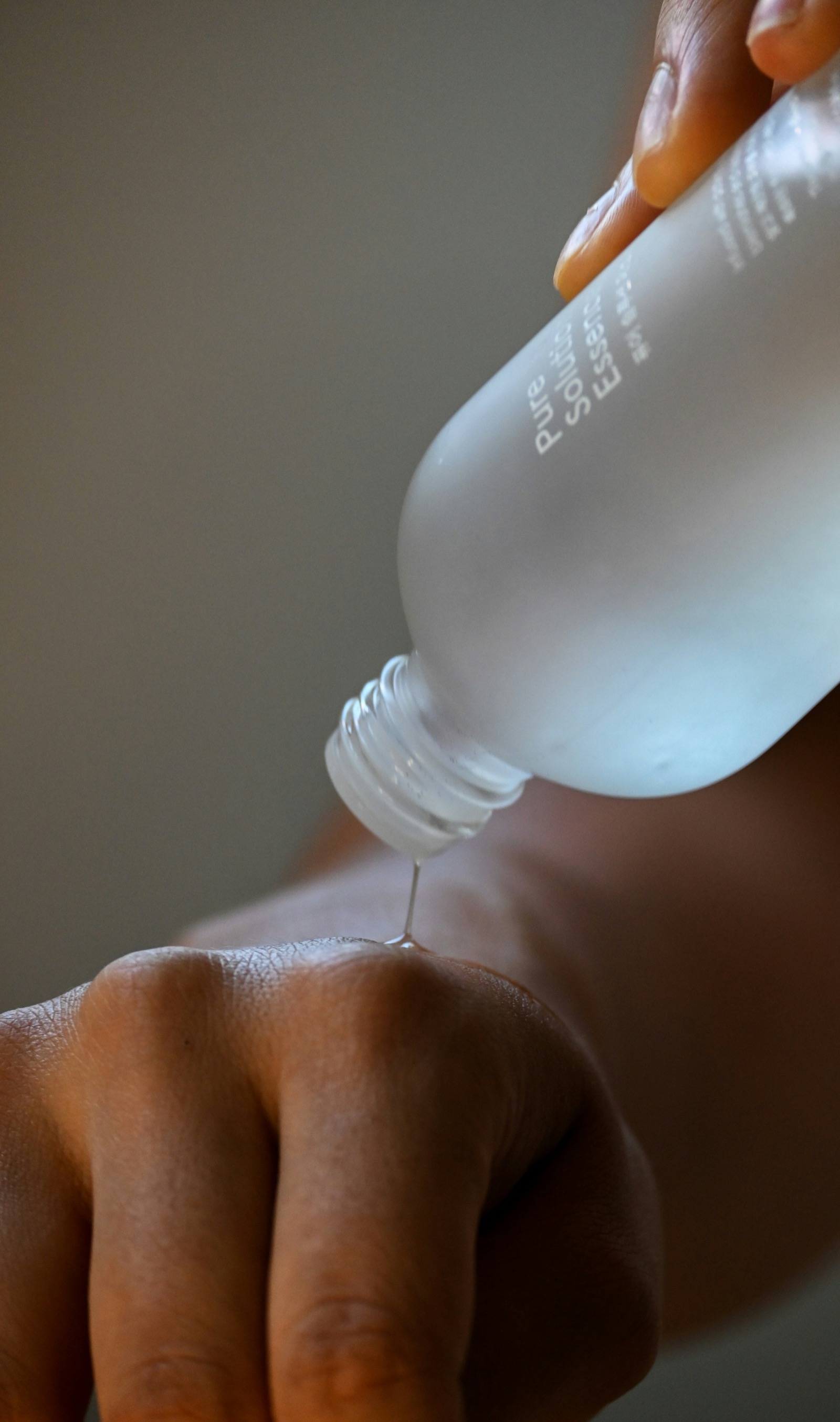
When international skincare enthusiasts first encounter a bottle of Japanese keshosui, a common initial reaction is skepticism. Pouring a clear splash into the palms, the liquid appears virtually indistinguishable from mineral water. There is no heavy gel drag, no greasy film, and no astringent sting.
Yet within seconds of pressing this watery fluid across the face, the skin softens and plumps in a way that plain water never could. In cosmetic science, a lotion is intended for application to skin for moisturizing, protective, cosmetic, or medicinal purposes[1] across wide surface areas. In the context of Japanese skincare, this watery simplicity represents decades of colloid engineering and sensory refinement designed around the principle of gentle, unhurried hydration.
1. The Cultural Philosophy: Water as the Foundation of Translucence
In Western beauty traditions, "toners" historically served as astringents or secondary cleansing agents. Formulated with alcohol, witch hazel, or exfoliating acids, their primary function was removing stubborn cleanser residue and constricting surface pores.
Japanese beauty (J-beauty) approaches toner from the opposite perspective:
Replenishment Over Astringency
To Japanese formulators, the skin after cleansing is a thirsty sponge. Cleansing lifts away oxidized lipids, but it also temporarily disturbs the skin's surface water content. Topical hydration quenches the stratum corneum, the outermost layer of the epidermis[2], restoring softness before heavier barrier creams are applied.
The Concept of Mochi-Hada
The sensory goal of Japanese lotion is mochi-hada—skin that mimics the soft, pillowy, hydrated bounce of a fresh rice cake. Achieving this texture requires saturating surface keratin with bio-compatible water rather than coating it with dense occlusive waxes right away.
2. The Formulation Chemistry: How Watery Lotions Carry Deep Moisture
How can a formula that flows like pure water deliver hours of sustained hydration? The answer lies in sophisticated fluid chemistry:
Balanced Polyol Networks
Rather than relying on high-viscosity gums (such as xanthan gum or carbomers) that create surface tackiness, Japanese chemists rely on polyols because glycerol is miscible with water and is hygroscopic in nature[3]. By pairing high-purity glycerin with dipropylene glycol (DPG), butylene glycol (BG), and diglycerin, formulators create a layered humectant grid that holds water at different atmospheric humidities without building a gummy residue.
Micro-Emulsion and Nanoscale Droplets
Advanced hydrating lotions incorporate micro-droplets where an emulsion is a mixture of two or more liquids that are normally immiscible[4]. By utilizing specialized micro-fluidizers, cosmetic chemists disperse trace amounts of squalane, rice ceramides, or jojoba esters into nanoscale droplets (often under 100 nanometers). Because the droplets are smaller than the wavelength of visible light, the lotion remains crystal clear and completely watery while delivering essential barrier lipids.
Multi-Weight Hyaluronic Complexes
Biotechnology provides humectants such as hyaluronic acid, one of the chief components of the extracellular matrix[5]. Modern Japanese lotions frequently combine three to seven molecular weights of hyaluronic acid:
- High molecular weight: Forms a flexible moisture shield on the surface to curb trans-epidermal water loss.
- Medium molecular weight: Fills microscopic fissures between corneocytes.
- Hydrolyzed nano-hyaluronic acid: Sinks into the upper stratum corneum to anchor long-lasting moisture.
3. Comparing Western Toners, Korean Essences, and Japanese Keshosui
To navigate the global skincare counter, it helps to understand how Japanese essence lotions compare with related liquid categories:
Scroll horizontally to view full table
| Attribute | Japanese Essence Lotion (*Keshosui*) | Western Clarifying Toner | Korean Hydrating Essence |
|---|---|---|---|
| Core Purpose | Deep barrier saturation & conditioning | Secondary cleansing & astringency | Targeted care & active delivery |
| Viscosity / Texture | Watery fluid (ultra-light to *shittori*) | Watery, often alcohol-based | Slightly viscous, slippery gel-liquid |
| Key Ingredients | Polyols, amino acids, ceramides, ferments | AHA/BHA, witch hazel, alcohol, botanicals | Snail mucin, galactomyces, propolis |
| Application Method | Generous palm patting or lotion masks | Swipe with cotton pad | Gentle patting with palms |
| After-Feel | Plump, supple, zero residue or tack | Tight, matte, clean finish | Dewy, slight tacky hydration sheen |