title: Japanese Neck and Decollete Skincare: Daily Care Guide h1: "Japanese Neck and Decollete Skincare: Daily Care Guide" description: "Elevate your Japanese neck and decollete skincare routine. Learn anatomical vulnerabilities, upward massage motions, UV defense, and barrier hydration tips." meta_description: Elevate your Japanese neck and decollete skincare routine. Learn anatomical vulnerabilities, upward massage motions, UV defense, and barrier hydration tips. category: "how-japan-works" slug: "japanese-neck-and-decollete-skincare" publish: true published_at: "2026-11-17" hero_image: "/images/stock/woman-applying-skincare-product-neck-morning.jpg" hero_image_alt: "Woman gently applying hydrating skincare lotion to her neck and upper chest in morning light"
Japanese Neck and Decollete Skincare: Daily Care Guide
In Japanese aesthetics, a graceful neckline and smooth chest—traditionally celebrated through the refined silhouette of the kimono collar (eri-ashi)—are considered just as vital to one's beauty as clear facial skin. A common saying among Japanese aestheticians is that "the face does not end at the chin; it ends at the collarbones." Despite this philosophy, many skincare enthusiasts diligently layer serums and sunscreens over their cheeks while neglecting the throat and upper chest, leading to premature creping, horizontal creases, and uneven sun pigmentation.
Japanese neck and decollete care considers the throat and chest a direct continuation of the face. Because neck skin is thinner, contains far fewer oil glands, and is constantly flexed by posture, it dehydrates rapidly. The Japanese approach centers on four core habits: extending facial lotion (*keshosui*) and emulsion (*nyueki*) downward every morning and night, applying daily broad-spectrum sunscreen right down to the collarbones, using feather-light upward palm glides without harsh pulling, and maintaining posture awareness to prevent tech-neck horizontal lines.

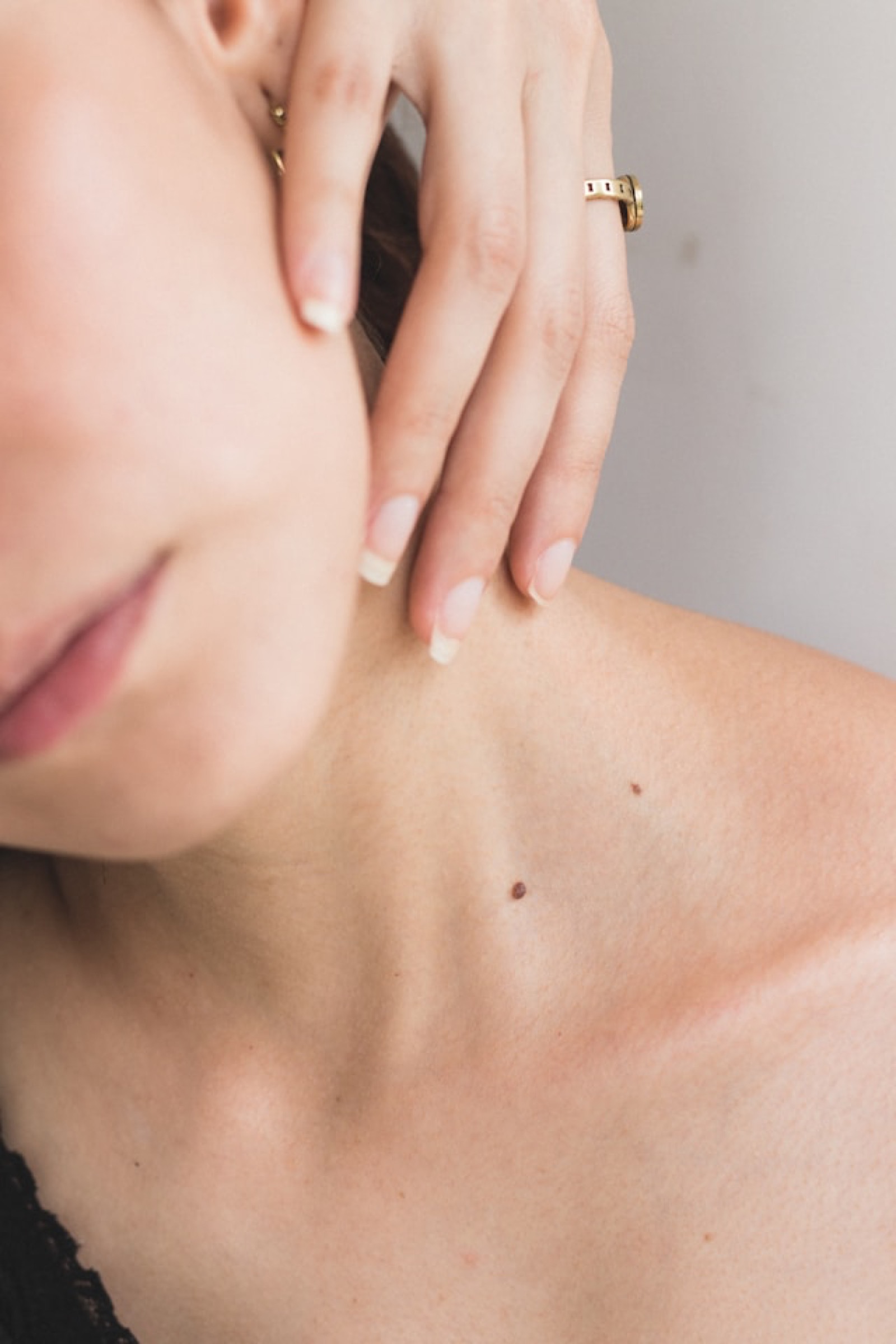
Extending your daily facial skincare downward ensures the delicate neck and decollete remain supple and protected.
Anatomy of the neck and chest: Why this zone ages faster
To appreciate why the neck requires specialized gentleness, one must understand its unique dermatological structure compared to the face:
1. Fragile epidermis and sparse sebaceous glands
The stratum corneum, which is the outermost layer of the epidermis [2] that acts as the body's primary moisture barrier, is substantially thinner on the neck than on the cheeks or forehead. Furthermore, the anterior neck possesses significantly fewer sebaceous (oil) glands. Without a steady supply of natural sebum to form an emollient acid mantle, the throat is chronically prone to transepidermal moisture loss and dry crepiness.
2. Dermal collagen vulnerabilities
Beneath the surface, the dermis is a layer of skin between the epidermis [3] and subcutaneous tissues that houses supportive collagen and elastin networks. Because chest and neck skin is frequently exposed to incidental sunlight—through open necklines, blouses, and car windows—ultraviolet radiation breaks down structural dermal fibers rapidly. When UV damage accumulates without daily sunscreen defense, the decollete develops coarse crinkling, mottled pigmentation, and loss of rebound elasticity.
3. The superficial platysma sheet
Unlike facial muscles that anchor firmly to facial bones, the platysma is a superficial muscle of the human neck [1] that originates over the upper chest fascia and inserts into the lower jaw. Because this muscle forms a broad, paper-thin sheet directly beneath the skin, continuous downward head tilting—such as looking down at smartphones or laptops ("tech-neck")—places persistent compressive stress on the skin, etching deep horizontal creases across the throat over time.
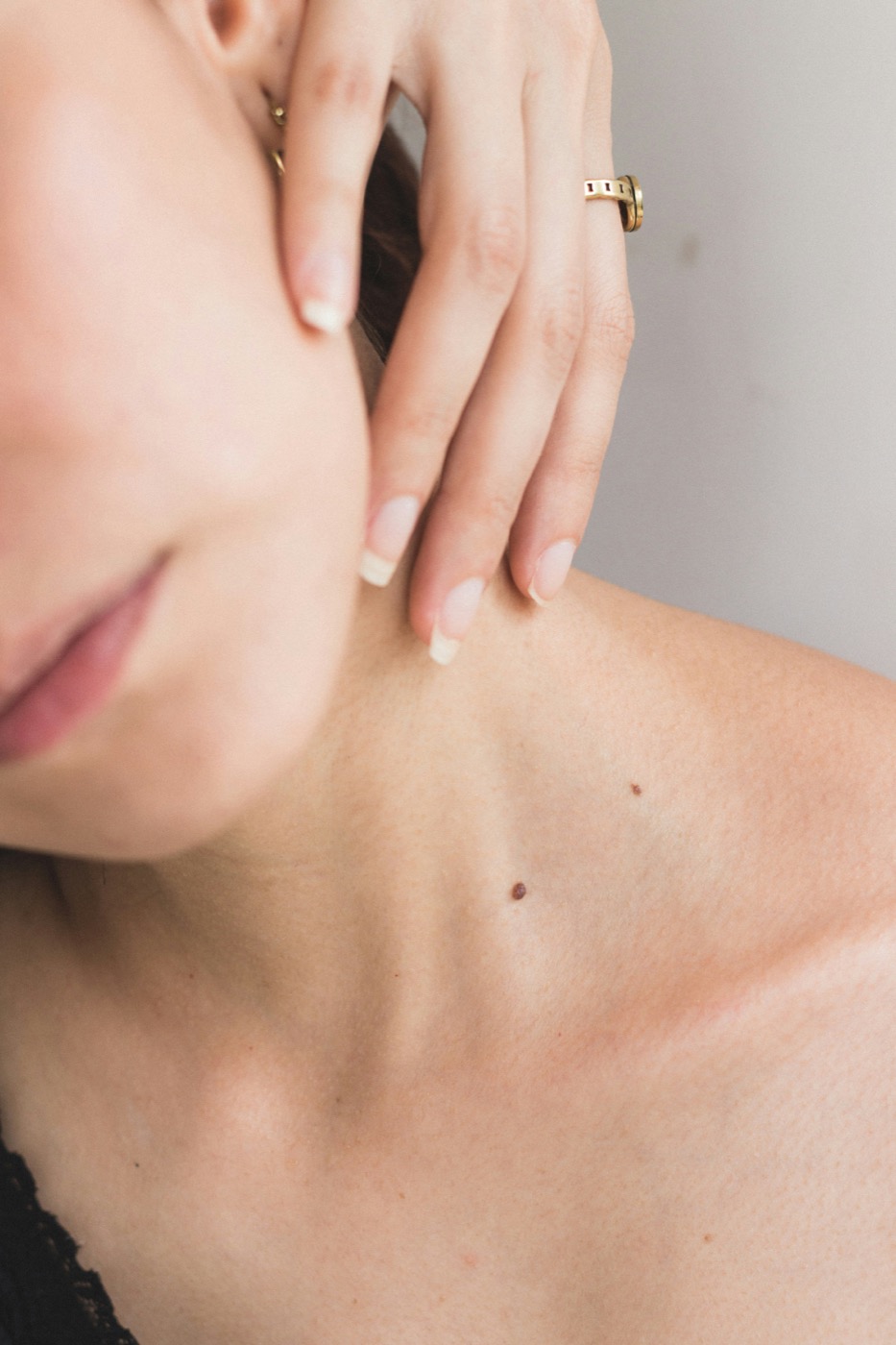
Sparse sebaceous glands and thin epidermal layers make the throat exceptionally prone to dryness and creping.
Step-by-step Japanese neck and decollete routine
Japanese skincare incorporates neck care naturally into daily morning and evening rituals. Follow this five-step sequence:
1. Gentle, non-abrasive cleansing
Never scrub the throat with coarse loofahs or body washcloths. The American Academy of Dermatology highlights this principle, reminding individuals to wet your face with lukewarm water and use your fingertips to apply cleanser [4] rather than harsh tools. In the shower, glide a dense cloud of lather over the neck and chest using your open palms, rinsing with mild lukewarm water.
2. Aqueous hydration extension (Keshosui)
When applying your daily watery facial lotion, pour an extra coin-sized amount into your palms. Lightly press the fluid upward from the collarbones toward the jawline, wrapping your hands around the sides of the neck. This floods dehydrated corneocytes with water-binding humectants like hyaluronic acid and amino acids.
3. Upward emulsion sealing (Nyueki)
Follow immediately with your daily facial emulsion or moisturizing milk. Using the flat pads of your fingers and open palms, glide the cream upward in long, gentle strokes from the base of the throat toward the chin. This upward motion aligns with Japanese massage philosophy, supporting natural skin tension and avoiding downward tugging on the fragile platysma.
4. Downward lymphatic drainage toward collarbones
To ease puffiness and support peripheral circulation, sweep your flat hands gently outward from beneath the ears, gliding downward along the sternocleidomastoid muscle toward the hollow above your collarbones (the supraclavicular lymph nodes). Apply zero downward pressure; let the slip of your emulsion cushion the touch.
5. Daily broad-spectrum UV protection to the chest
In the morning, never stop sunscreen application at the chin. Apply an adequate nickel-sized portion of broad-spectrum sunscreen across your throat, back of the neck, and upper decollete. Reapply diligently when wearing scoop-neck clothing or spending time outdoors.
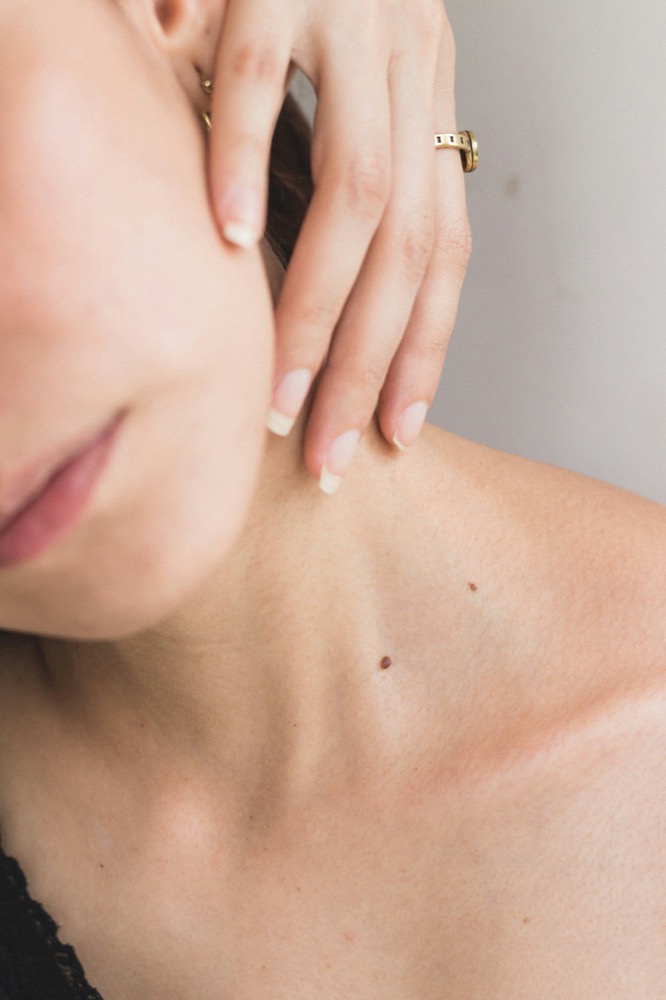
Daily broad-spectrum sunscreen applied to the collarbones shields delicate dermal collagen from incidental UV breakdown.
Comparison table: Facial skin vs neck and decollete skin
Understanding the contrasting needs of facial versus neck tissue helps clarify why neck care requires extra emollience and minimal friction.
Scroll horizontally to view full table →
| Anatomical Feature | Facial Skin (Cheeks & T-Zone) | Neck & Decollete Skin | Primary Vulnerability | Japanese Care Priority |
|---|---|---|---|---|
| Epidermal Thickness | Moderate (0.05 to 0.1 mm) | Extremely thin (approx. 30% thinner) | Rapid moisture evaporation; fine surface creping | Generous watery lotion flooding (*keshosui*) |
| Sebaceous Gland Density | Dense (400-900 glands/cm²) | Sparse (<100 glands/cm²) | Chronic lack of natural protective sebum | Lipid-rich emulsion or ceramide milk seal |
| Muscular Support | Firm bony insertions (mimetic muscles) | Free-floating superficial sheet (platysma) | Gravitational sagging and posture creases | Upward palm glides; chin posture alignment |
| UV Exposure Angle | Direct forward exposure | Horizontal shelf (decollete) & side angles | Accumulated sun spots and photo-damage | Daily sunscreen extended to collarbones |