title: Japanese Silicone Mask Covers: Sheet Mask Hack Guide slug: japanese-silicone-mask-cover-sheet-mask-hack category: how-japan-works published_at: '2026-11-23' updated_at: '2026-11-23' meta_description: Discover the Japanese silicone mask cover hack. Learn how reusable Daiso covers prevent serum evaporation, lock in moisture, and secure sheet masks. keywords:
- japanese silicone mask cover sheet mask hack
- daiso silicone moisturizing mask 3d
- reusable silicone sheet mask cover japan
- prevent sheet mask evaporation hack
- silicone bath steam mask routine lead_image: /images/stock/woman-applying-sheet-mask-bathroom.webp lead_image_alt: Woman smoothing a hydrating facial sheet mask onto her face in a modern bathroom thumbnail: /images/stock/woman-applying-sheet-mask-bathroom.webp thumbnail_alt: Woman smoothing a hydrating facial sheet mask onto her face in a modern bathroom author: Editorial Team publish: true
Japanese Silicone Mask Covers: Sheet Mask Hack Guide
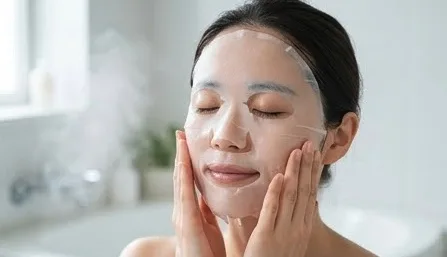
Sheet masks are a beloved staple of Japanese hydration rituals, but ordinary cotton and non-woven fabric masks suffer from two common frustrations: they dry out rapidly under domestic indoor heating or air conditioning, and they slide off the moment you stand up. To solve this, Japanese beauty innovators created reusable silicone mask covers (silicone uruoi mask). Originally popularized as an affordable 100-yen drugstore staple, this simple silicone shield has become a viral global skincare hack.
Quick answer: A Japanese silicone mask cover is an elastic, reusable silicone overlay placed directly over an ordinary cotton sheet mask. Featuring integrated ear loops, it physically anchors the wet sheet to prevent slippage while creating an airtight barrier. This occlusive wrap prevents ambient air from evaporating expensive essence, ensuring deeper epidermal hydration. It can also be worn alone during a hot bath to create a reusable facial steam mask.

The Occlusive Science: How Silicone Prevents Evaporation
When you apply a damp cotton sheet mask to your face, water and volatile solvents immediately begin evaporating into dry ambient air. Within 10 to 15 minutes, the edges dry out and can pull moisture back out of the superficial stratum corneum via reverse osmosis.
Pioneered by global 100-yen retail giant Daiso Industries, viral Japanese silicone mask covers democratized professional-style occlusive masking[3]. According to manufacturer technical specifications, layering the silicone cover over a cotton sheet mask generates an occlusive plastic-wrap barrier that prevents air conditioning from evaporating active cosmetic serum[1].
By trapping moisture beneath a non-porous silicone film, the cover produces several key physiological advantages:
- Enhanced Trans-Epidermal Hydration: The physical barrier prevents trans-epidermal water loss (TEWL) during application, maintaining constant liquid contact with surface corneocytes.
- Uniform Moisture Distribution: Even if room humidity is low, the sheet mask underneath remains completely drenched until removal.
- Thermal Trap: Natural body heat radiating from the facial capillaries is trapped, gently warming the skin and softening keratinized pore openings.

Freedom of Movement: The Ear-Loop Anchor Mechanism
Traditional sheet masking demands lying motionless on a bed or sofa to prevent the wet fabric from sliding down the jawline. Japanese silicone covers overcome this limitation through mechanical ergonomics.
In official product designs, ergonomic integrated ear loops anchor the mask firmly to prevent slippage while walking around or performing household tasks[1]. With both ears holding the silicone tension, users can read, cook, dry their hair, or work at a computer while masking, converting sedentary skincare time into an active daily routine.
The Bathhouse Steam Mask Variation
Beyond sheet mask enhancement, Japanese consumers frequently utilize the bare silicone cover in the bathroom. Official product guidelines highlight that wearing the bare silicone sheet during a warm bath transforms it into a reusable steam mask to encourage perspiration and pore relaxation[1]. The rising bathtub vapor warms the trapped air inside the silicone shield, creating an at-home facial sauna effect without electricity.
Formats Compared: 3D Contoured vs. 2-Way Separate Covers
As the popularity of silicone covers expanded, Japanese manufacturers introduced anatomical variations to accommodate diverse facial dimensions and routine preferences.
| Mask Design | Key Structural Features | Primary Advantage | Fit Profile |
|---|---|---|---|
| Classic Full-Face 3D | Single molded silicone sheet with center nose seam | Quick one-step application; full forehead coverage | Standard facial proportions; adjustable ear slits |
| 2-Way Separate (Upper/Lower) | Split two-piece format covering forehead and lower jaw | Custom overlapping fit; adaptable to longer faces | High customization; versatile for zone masking |
| Earless Visor Band | Strapless silicone shield held by temple pressure | Zero ear tension; ideal for sensitive cartilage | Short sessions; sedentary relaxation |
| Eye & Smile Line Half-Mask | Targeted silicone patches for periocular and nasolabial folds | Concentrated occlusion over targeted serums | Spot care; layered over multi-step routines |