slug: why-do-japanese-women-look-younger-myth title: Do Japanese Women Look Younger? The Science Behind the Myth meta_description: Do Japanese women look younger? A cautious look at the limited research, individual variation, and the sun protection and skincare habits often credited. date: "2026-11-17" category: how-japan-works tags:
- Japanese aging myths
- skin longevity
- photoprotection culture
- dermatological science
Do Japanese Women Look Younger? The Science Behind the Myth

Memes, travel blogs, and beauty forums often say that Japanese women look younger than their age. It is a popular impression, not a measured fact about any one person. This guide separates what research can and cannot say from the everyday habits people often credit, and it avoids treating a whole population as one skin type.
There is no evidence that Japanese women age slower as a group. A few small studies comparing populations (for example Chinese and French women) report that fine wrinkles appear later but dark spots become a bigger sign of age, and the authors call their results preliminary[1]. Differences between individuals are far larger than differences between averages. Habits matter at least as much: one industry-linked study attributes roughly 80% of visible facial aging signs to UV exposure[3], and daily sun protection, gentle cleansing, and moisturizing are common in Japan. These habits are available to anyone.
What research can and cannot say
Reviews of how skin ages across ethnic groups note that darker skin tends to show some wrinkles and sagging later, while uneven pigmentation (dark spots) is one of the most common aging signs in skin types III to VI[2]. A pilot study comparing Chinese and French women reported that wrinkle onset appeared about 10 years later in the Chinese group, but pigmented spots were a much more prominent sign, and the authors said the findings needed confirmation in larger studies[1].
Three cautions apply when reading these results:
- They compare averages, not individuals. Within any group, people vary widely in skin type, sun history, and genetics.
- They study specific groups. Results about Chinese or European women cannot be assumed to describe all Japanese women, and Japan is not a single skin type.
- Perceived age is subjective. How young a face looks to an observer depends on hair, makeup, lighting, expression, and the observer's own expectations.
For these reasons, this article does not claim that bone structure, collagen, or melanin explains why anyone looks younger. Those mechanisms are discussed in the research literature, but they should not be applied to a person based on nationality or appearance.
The habit most often credited: lifelong sun protection
In Japan, sun protection is a common year-round habit. Many people carry UV-blocking parasols (higasa), wear hats and arm covers, and use daily sunscreen. Japanese drugstore sunscreens are often watery gels or milks that people find comfortable enough to use every day.
Research on Caucasian women found that sun exposure was strongly linked to pigmentation changes at every age, and the authors estimated that about 80% of visible facial aging signs relate to UV exposure[3]. Because the study's authors were affiliated with a cosmetics company and the estimate is theirs, treat the number as a rough guide rather than a settled fact. The practical takeaway is more modest: consistent daily sun protection is one of the most widely recommended habits for the look of the skin over time.
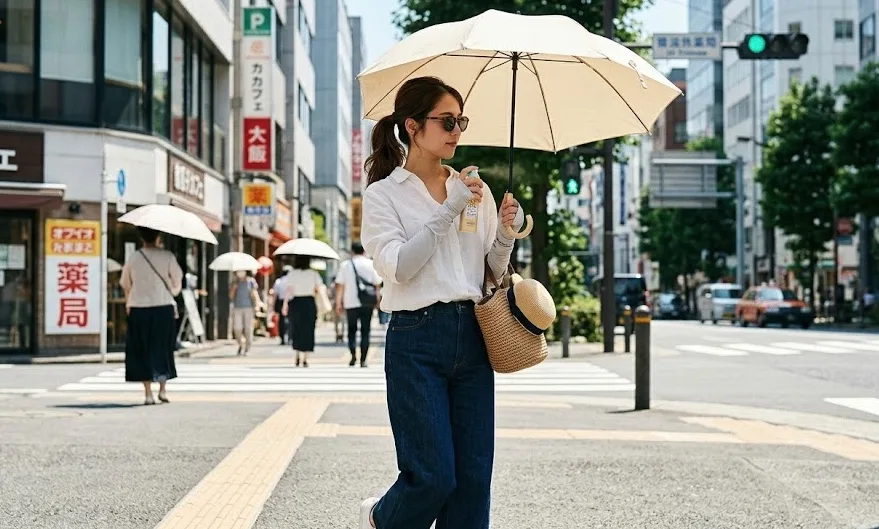
Everyday routines often associated with Japan
These habits are cultural patterns, and results vary:
- Daily sunscreen and shade. Sunscreen labeled SPF 50+ / PA++++ is easy to find. Reapply as the label directs.
- Gentle cleansing. Foaming cleansers are commonly whipped into a dense lather so that fingers glide over foam instead of dragging on skin.
- Layered hydration. A watery lotion (keshosui) followed by an emulsion (nyueki) is a common way to add and seal in surface moisture.
- Traditional meals. Washoku emphasizes fish, vegetables, soy, and tea. A balanced diet supports general health, but no food has been shown to make a person look younger.

The other side: aging is not absent
The idea that Japanese women "do not age" is an oversimplification. Dark spots and uneven tone are frequently reported as primary concerns in studies of East Asian women[1][2]. Sun protection, gentle care of blemishes and bites (which can leave marks that take time to soften in appearance), and avoiding picking are practical ways to manage these concerns. Changes in facial volume and skin firmness also occur with age in every population.
Signs to stop and when to see a doctor
Daily habits support the look of the skin, but changes in a mole or skin lesion need professional evaluation. Consult a board-certified dermatologist if you notice:
- A changing dark spot: irregular borders, multiple colors, rapid growth, or bleeding.
- A rough, scaly, or non-healing patch that does not improve with moisturizer.
- Persistent redness, burning, or stinging after using a new product. Stop using it and wash with lukewarm water.
- Sudden asymmetry or drooping of the face, which needs urgent medical attention.
FAQ: Japanese Aging Perception & Skin Science
Q1. Do Japanese women get wrinkles later than Western women?
A. Some small studies report later wrinkle onset in East Asian women, but results are preliminary.(Details)
Some small studies comparing other populations report later wrinkle onset in East Asian women, but the authors describe the results as preliminary and they do not predict any individual[1]. Sun exposure, smoking, genetics, and skincare habits all matter.
Q2. What is a common sign of aging if not wrinkles?
A. Uneven tone and dark spots are commonly reported as prominent aging signs.(Details)
Uneven tone and dark spots are commonly reported as prominent aging signs in skin types III to VI[2]. Daily sunscreen and gentle care are the usual starting point; for stubborn spots, ask a dermatologist.
Q3. How much does sun protection matter?
A. One industry-linked study estimates about 80% of visible facial aging signs relate to UV exposure.(Details)
One study of Caucasian women by cosmetics-company researchers estimated that about 80% of visible facial aging signs relate to UV exposure[3]. Exact numbers vary, but daily sun protection is widely recommended.
Q4. Do genetics matter more than habits?
A. Both matter; habits are the part you can change.(Details)
Both matter, and their relative weight differs between people. Habits such as sun protection, not smoking, and gentle skincare are the part you can change.
Q5. Can Japanese skincare make anyone look younger?
A. No routine can promise that; consistent sun protection and gentle care support the look of the skin.(Details)
Sunscreen, gentle cleansing, and moisturizing are widely recommended habits for the look of the skin, but individual results vary. See a dermatologist for concerns about pigmentation or skin changes.
Summary
- No group ages "slower": small population studies report average differences, but individual variation is larger and results are preliminary.
- Sun protection is the habit most often credited: parasols, hats, and daily sunscreen are common in Japan and available to anyone.
- Aging still happens: dark spots and changes in firmness are common concerns.
- Be cautious with stereotypes: perceived youthfulness is subjective and should not be attributed to nationality or bone structure.
References
- Nouveau-Richard S, Yang Z, Mac-Mary S, et al. Skin ageing: a comparison between Chinese and European populations. A pilot study. J Dermatol Sci. 2005;40(3):187-193. https://pubmed.ncbi.nlm.nih.gov/16154324/
- Vashi NA, de Castro Maymone MB, Kundu RV. Aging differences in ethnic skin. J Clin Aesthet Dermatol. 2016;9(1):31-38. https://pmc.ncbi.nlm.nih.gov/articles/PMC4756870/
- Flament F, Bazin R, Laquieze S, et al. Effect of the sun on visible clinical signs of aging in Caucasian skin. Clin Cosmet Investig Dermatol. 2013;6:221-232. https://pubmed.ncbi.nlm.nih.gov/24101874/
Disclaimer: This article is for general information and education about Japanese cosmetics and their labels. It is not a substitute for professional medical advice, diagnosis, or treatment. Skincare results vary from person to person. Product formulas, availability, prices, and regulations change, and products sold in Japan can differ from versions sold elsewhere, so always check the current label. Do a patch test before introducing a new product, and consult a doctor or dermatologist if you have a skin condition or specific concerns.