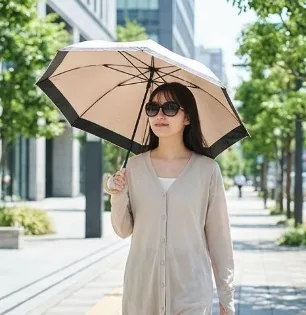
title: Why Japanese Avoid the Sun: Parasols & UV Culture h1: "Why Japanese Avoid the Sun: Parasols & UV Culture" description: "Discover why Japanese people avoid the sun. Learn about UV parasols, arm covers, photoaging defense, and the cultural mindset behind J-Beauty sun habits." meta_description: Discover why Japanese people avoid the sun. Learn about UV parasols, arm covers, photoaging defense, and the cultural mindset behind J-Beauty sun habits. category: "how-japan-works" slug: "why-japanese-avoid-sun-uv-culture-parasol" publish: true published_at: "2026-11-17" hero_image: "/images/stock/woman-parasol-uv-protection.webp" hero_image_alt: "Woman carrying a black UV-blocking parasol walking outdoors in bright sunlight"
Why Japanese Avoid the Sun: Parasols & UV Culture
Visitors exploring Japanese cities between May and October frequently marvel at a distinctive street scene. Under cloudless summer skies, commuters unfurl lightweight parasols, cyclists wear full-length cooling arm sleeves, and pedestrians navigate sidewalks by seeking every strip of building shade.
While Western summer cultures celebrate bronzed tans and sunbathing, Japanese society approaches direct solar exposure with meticulous caution. In Japan, sun protection is approached not as an occasional beach day measure, but as an essential year-round health and anti-aging protocol deeply rooted in dermatological science, textile technology, and historical aesthetics.
Japanese sun avoidance stems from a dual foundation: an acute scientific awareness that ultraviolet radiation drives over 80% of visible skin photoaging (wrinkles, loss of elasticity, and hyperpigmentation), combined with a historical aesthetic reverence for clear, unblemished skin (*bihaku*). To defend against harsh solar exposure without relying solely on topical chemicals, Japanese culture embraces multi-layered physical defense—pairing high-PA broad-spectrum sunscreens with specialized UV blackout parasols (*higasa*), UV-blocking clothing, and breathable arm covers.
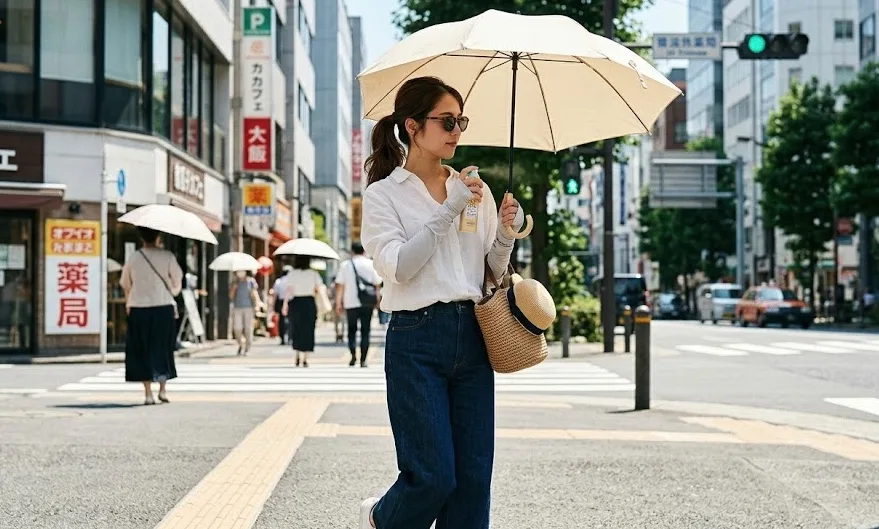
UV parasols provide an immediate portable shadow, lowering perceived temperature while blocking direct and scattered solar rays.
The Visual Phenomenon: Parasols, Visors, and Arm Covers
To newcomers, the sheer variety of physical sun-blocking accessories in Japan can seem astonishing.
An umbrella is fundamentally a folding canopy designed to protect against rain or sunlight[1]. However, in Japan, the modern sun parasol (higasa) has evolved into an advanced optical shield. Unlike casual Western rain umbrellas that allow substantial ultraviolet transmission, Japanese certified UV parasols utilize multi-layered polyurethane laminate coatings that deliver 99.99% to 100% complete blackout (kanzen shako) and substantial infrared thermal reflection.
Beyond parasols, Japanese streets feature an array of protective apparel:
- UV Arm Covers (Ude Kaba): Elastic sleeves woven from ceramic-infused, contact-cooling fibers (sesshoku reikan) that shield arms during cycling or driving.
- Wide-Brimmed UV Hats & Visors: Large, adjustable hats lined with ultraviolet-absorbing films that shade the entire face, neck, and ears.
- Face Covers (Yake-nu): Breathable, mask-like fabric drapes worn by tennis players, gardeners, and outdoor workers to shield the cheeks and neck without trapping exhaled moisture.
Biological & Dermatological Drivers: Photoaging vs Chronological Aging
While cultural traditions laid the groundwork for sun avoidance, contemporary Japanese habits are fiercely reinforced by dermatological education.
Solar ultraviolet light is a form of electromagnetic radiation[2] that reaches the Earth's surface in two biologically active bands: UVB (short wavelength, responsible for surface sunburn and DNA damage) and UVA (long wavelength, which reaches through windows and clouds).
Dermatologists classify the visible signs of skin degradation into natural chronological aging and extrinsic photoaging. Crucially, dermatological science demonstrates that chronic changes to skin induced by chronic uva and uvb exposure[3] account for the vast majority of premature facial wrinkles, structural collagen breakdown, and localized melanin clusters (age spots or shimi).
In Japan, consumer awareness of UVA-induced elastosis is exceptionally high. Rather than waiting for dark spots to form and seeking aggressive clinical lasers later, Japanese skincare philosophy focuses on relentless upstream defense. By preventing solar photons from striking melanocytes and dermal fibroblasts in the first place, the skin preserves its native collagen lattice for decades.
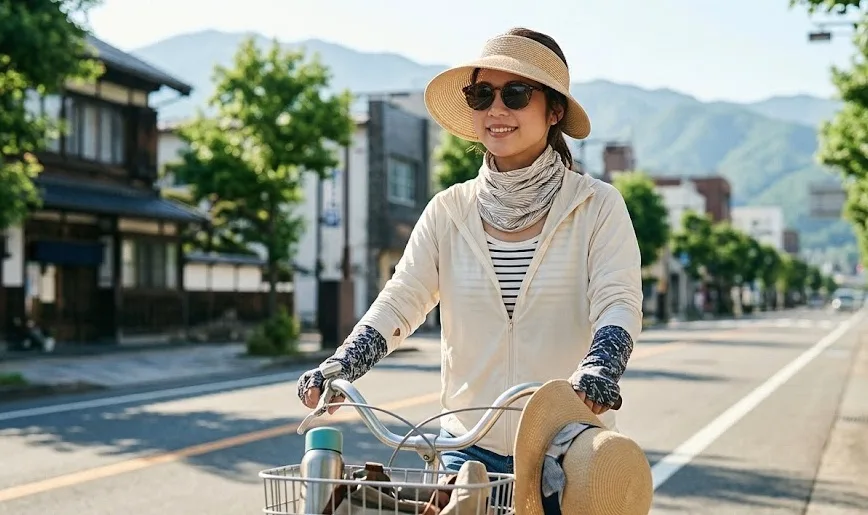
Urban commuters frequently combine long sleeves and shaded brim hats to shield against UV while cycling through open streets.
Cultural Roots: The Historical Esteem for Fair, Unblemished Skin
The modern obsession with UV defense is reinforced by centuries of cultural history. An ancient Japanese proverb states: Iro no shiroi wa shichinan kakusu—"A fair complexion conceals seven flaws."
Historically, untanned skin was a prominent social signifier. In pre-industrial Japan, rural farmers and outdoor laborers developed weathered, sun-darkened skin through continuous fieldwork. Conversely, aristocrats, scholars, and wealthy merchants spent their days indoors, naturally maintaining smooth, unpigmented complexions. Over centuries, pale, luminous skin became synonymous with refinement, gentility, and self-discipline.
In the modern era, this aesthetic has shifted away from class elitism toward a broader pursuit of skin clarity and radiant health (bihaku). Modern Japanese consumers do not seek a ghostly, unnatural pallor; rather, they prize an even, glowing tone free from sun-induced roughness, persistent redness, and premature dermal sagging.
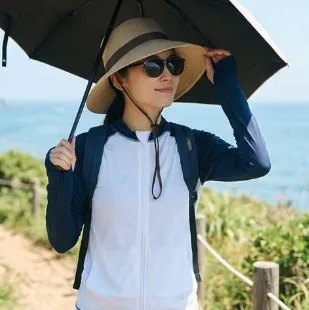
Comprehensive physical shielding protects the fragile skin of the neck and chest, areas exceptionally prone to photoaging.
Comparing Physical UV Barriers vs Topical Sunscreens
Rather than choosing between topical lotions and physical tools, Japanese dermatological practice integrates both into a complementary dual barrier.
Scroll horizontally to view full table
| Attribute | Physical Barriers (Parasols & Arm Covers) | Topical Sunscreen Formulations |
|---|---|---|
| Primary Defense Mode | 100% opaque fabric absorption and physical reflection | Chemical (organic) filters absorb; mineral filters scatter |
| Reapplication Requirement | Zero reapplication needed; shields indefinitely | Must be reapplied every 2 to 3 hours due to sweat/rub-off |
| Barrier Sensitivity Risk | Zero chemical contact or pore-clogging potential | Certain UV filters can irritate reactive or sensitized barriers |
| Thermal Heat Relief | Can lower ambient under-canopy temperature by 3°C–5°C | Does not reduce thermal heat; some filters feel warming |
| Ground-Reflected UV Defense | Cannot block upward reflection from asphalt (10%–20%) | Defends against scattered and reflected photons directly |