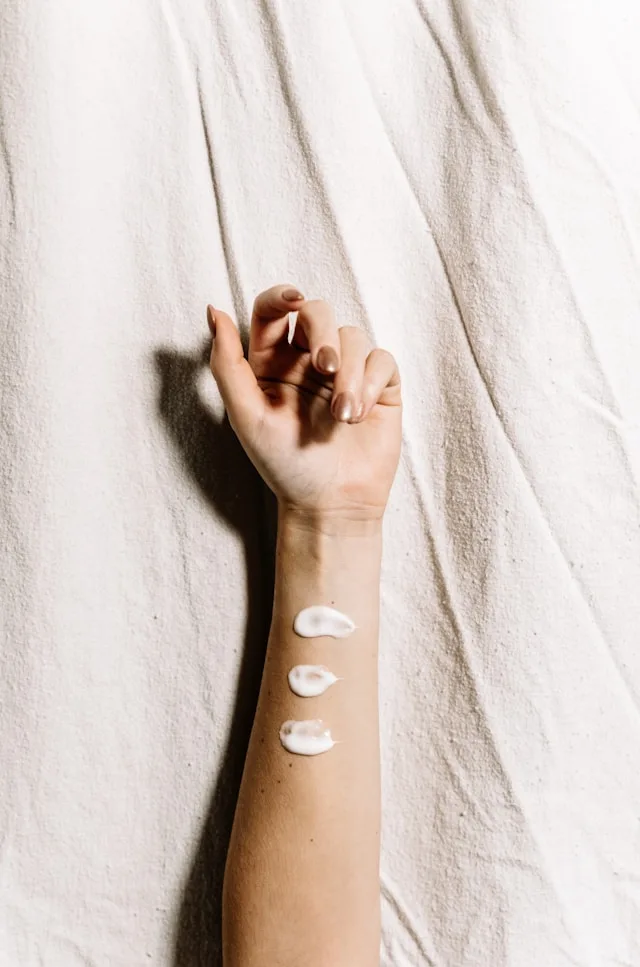
title: Japanese Color Correcting Primer: Purple vs Yellow Base slug: japanese-color-correcting-primer-purple-yellow-base category: routines published_at: 2026-11-22 updated_at: 2026-11-22 author: Seibun Lab Editorial Team hero_image: /images/stock/forearm-three-cream-swatches-patch-test.webp hero_image_alt: Three shades of tinted cosmetic bases swatched on forearm demonstrating color correction meta_description: Master Japanese color correcting primers. Learn when to use purple versus yellow base for dullness, redness, and undertone harmony with practical tips. tags: ["color correcting primer", "purple primer", "yellow primer", "tone up base", "j-beauty routines", "routines"] summary: "Understand the color theory behind Japanese purple and yellow makeup primers. Learn how to neutralize sallowness, balance hyperpigmentation, and zone-correct." publish: true
Japanese Color Correcting Primer: Purple vs Yellow Base
Purple (Lavender) Base: Combines blue (which diffuses yellow sallowness) and pink (which injects healthy blood-tone flush). Best for dull, fatigued skin, afternoon grayness, or anyone seeking ethereal porcelain translucency.
Yellow Base: The ultimate tone equalizer. Neutralizes superficial facial redness, brownish acne marks, dark under-eye circles, and uneven pigmentation while blending harmoniously into warm and olive undertones without ashen flashback.
Zone Correction Rule: You do not need to choose just one. Japanese makeup artists apply purple primer to the high center of the face (forehead, cheek tops) for luminous projection, and yellow primer to the periorbital and perioral zones to balance fatigue.
The Optical Color Wheel: How J-Beauty Corrects Undertones
Color correction relies on complementary color harmony: placing opposite wavelengths of light beside or over one another to cancel out visual saturation.
Complementary Color Dynamics in Japanese Bases:

[ Purple / Lavender ] (Opposite to Yellow)
Blue Waveform (Translucency) + Pink Waveform (Flushed Vitality)
-> Cancels out: Muddy yellow undertones, oxidized sallow complexion.
-> Visual Result: Brightened, porcelain clarity (*toumeikan*).

[ Yellow ] (Adjacent to Skin Pigmentation + Counter to Red/Brown)
Warm Golden Waveform (Melanin Alignment)
-> Cancels out: Redness around nostrils, purplish dark circles, brown discoloration.
-> Visual Result: Natural, unified bare-skin finish without ghost-like pallor.
Unlike Western color correctors which are frequently formulated as thick, opaque pastes meant to be buried under heavy concealer, Japanese control color primers are engineered as featherlight, semi-translucent fluid emulsions. They tint the skin's reflected light while allowing natural dermal texture to breathe.
Chemistry of Tone-Up Bases: UV and Pearl Coating
Modern Japanese color-correcting primers serve a dual purpose as high-performance daily sunscreens:
1. Optical Translucency and UV Defense
Premier formulas—such as Rohto's Skin Aqua Tone Up UV line—demonstrate how cosmetic science harnesses a lavender tint to bring out unique skin translucency while delivering UV defense[1]. Rather than using titanium dioxide that produces chalky white bounce-back, micro-fine blue and red optical pigments are suspended within a watery essence.
2. High-Adhesion Pearl Film
To maintain that newly applied glow throughout humid afternoons, the formula features coating agents that adhere pearl and UV filters to skin for lasting freshness[1]. These microscopic micro-pearls scatter ambient daylight across facial contours, blurring enlarged pores through optical diffusion.
3. Smooth, Streak-Free Distribution
Because color-correcting pigments can pool in dry epidermal crevices if applied haphazardly, dermatologists and formulators emphasize that you must apply an appropriate amount evenly over the skin to avoid patchy streaks[1].
Purple vs. Yellow Primer: Comprehensive Comparison
The table below breaks down the technical differences, benefits, and best applications for purple versus yellow Japanese primers.
Scroll horizontally to view full table
| Feature | Purple / Lavender Base | Yellow Base |
|---|---|---|
| Primary Optical Target | Yellow sallowness, tired dullness, fatigue | Facial redness, dark circles, brownish discoloration |
| Visual Finish | Porcelain, cool-toned transparency (*toumeikan*) | Healthy, unified, golden bare-skin vitality |
| Best Skin Undertones | Neutral to Cool, light-to-medium complexions | Warm, Olive, Neutral, and deeper complexions |
| Common Formulation Perks | Infused with micro-fine light-scattering pearl | Enriched with soothing cica, squalane, licorice |
| Caution / Pitfall | Can appear ashen if overapplied on deep warm skin | Will not create bright porcelain luminosity |
| Typical Price Range (JPY) | 800 - 1,500 (Drugstore) / 3,000 - 4,500 (Dept) | 800 - 1,500 (Drugstore) / 3,000 - 4,500 (Dept) |