title: Japanese Oil Control Powder: Midday Touch-Up Guide slug: japanese-oil-control-powder-midday-touch-up category: routines category_label: Routines & Guides published_at: '2026-11-23' updated_at: '2026-11-23' meta_description: Master the Japanese oil control powder technique for midday touch-ups. Learn porous silica science, blotting habits, and cake-free pressed powder methods. description: Master the Japanese oil control powder technique for midday touch-ups. Learn porous silica science, blotting habits, and cake-free pressed powder methods. hero_image: /images/stock/micro-fine-setting-powder-and-brush-texture.jpg hero_image_alt: Micro-fine setting powder texture with applicator brush for midday touch-ups thumbnail: /images/stock/micro-fine-setting-powder-and-brush-texture.jpg thumbnail_alt: Micro-fine setting powder texture with applicator brush for midday touch-ups reading_time: 6 author: Editorial Team publish: true
Japanese Oil Control Powder: Midday Touch-Up Guide
Quick answer
Japanese oil control pressed powders excel at midday touch-ups by utilizing porous silica microspheres that selectively absorb oxidized sebum without stripping essential epidermal moisture. Combined with micro-milled optical blurring micas, these portable compacts transform afternoon shine (tekari) into a smooth, silky-matte finish (sarasara) without caking over foundation or settling into facial pores.

By 2:00 PM on a typical workday, even carefully applied morning makeup confronts environmental stress. Office heating, summer humidity, and natural glandular activity cause facial sebum to mix with liquid foundation, leading to shine (tekari) along the T-zone and uneven separation around the nose. In many beauty cultures, the instinctive response is to dust heavy layers of powder over the face, which frequently results in cakey patches (kona-fuki) and clogged pores.
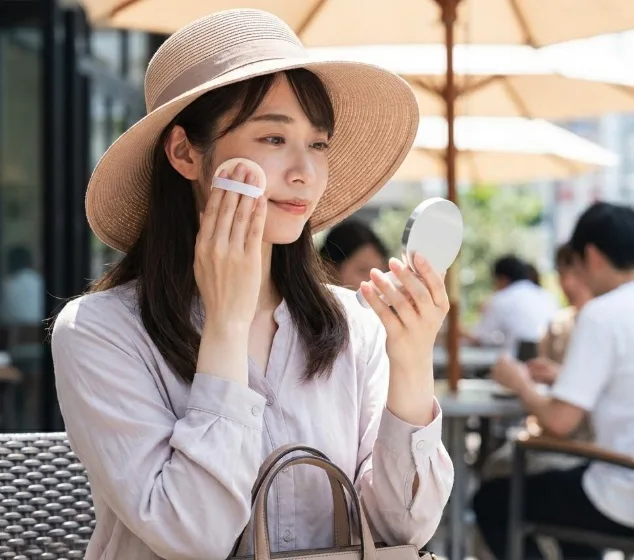
In Japan, the midday touch-up (keshou-naoshi) is practiced as a refined, step-by-step ritual. Japanese cosmetic chemists design oil control pressed powders specifically for portable, midday use—engineering porous mineral spheres that absorb sebum without removing underlying moisture. Here is your comprehensive guide to the powder science behind Japanese oil control compacts, how to blot correctly before powdering, and how to maintain a fresh, balanced complexion throughout the day.
The Particle Chemistry of Japanese Oil Control Powders
The difference between a heavy baking powder and a modern Japanese touch-up compact lies in mineral particle architecture:
1. Porous Silica Microspheres (Selective Sebum Adsorption)
Traditional talc-heavy powders absorb moisture indiscriminately, pulling both perspiration and essential cellular water from the stratum corneum, which triggers rebound oil production. Japanese laboratories employ spherical porous silica. Under electron microscopy, each microscopic silica bead resembles a tiny porous sponge with hollow interior cavities. These beads selectively trap lipophilic triglycerides and free fatty acids through capillary action while leaving hydrophilic skin moisture intact.
2. Platelet Micas and Soft-Focus Optics
Rather than relying on dense white chalk pigments that mask the skin with a pale cast, Japanese pressed powders incorporate micro-fine platelet micas coated with amino acid lipids. When light strikes these flat mineral platelets, it refracts diffusely, creating an optical soft-focus blur that disguises enlarged pores and textural irregularities.
Medical authorities recommend daily sunscreen application as an essential preventive measure to shield cellular DNA against cumulative photoaging and long-term damage.[2] Many Japanese oil control powders feature certified SPF 25 to SPF 50+ PA++++ filters, allowing you to replenish vital ultraviolet defense during your quick afternoon touch-up.

Why Midday Oil Management Protects Skin Health
Blotting and touching up afternoon oil is not merely a cosmetic preference; it plays an important physiological role in skin wellness:
- Preventing Squalene Oxidation: Human sebum contains roughly 12% squalene. When exposed to ambient ultraviolet light and atmospheric oxygen, squalene oxidizes into squalene monohydroperoxide, an irritating lipid byproduct that can provoke follicular micro-inflammation and comedones.
- Minimizing Pigment Clustering: When excess liquid sebum floats over foundation, surface tension pulls color pigments into clusters, creating patchy spots and visible settling inside pore openings.
- Preserving Barrier Comfort: Removing oxidized surface grease and resetting the barrier with a light mineral veil prevents midday itching and midday makeup breakdown.
Detailed Comparison: Japanese Oil Control Powder vs. Translucent Loose Powder vs. Blotting Paper Alone
The table below contrasts different midday shine control methods:
Scroll horizontally to view full table
| Feature | Japanese Oil Control Pressed Powder | Standard Translucent Loose Powder | Traditional Blotting Paper Alone |
|---|---|---|---|
| Portability | Slim, spill-proof compact with mirror and puff | Bulky jar; prone to powder spills in bags | Ultra-slim envelope; slips into pocket |
| Sebum Trapping | Porous silica traps oil while adding fresh veil | Absorbs oil but can cake if applied over wet sebum | Removes oil surface film only; adds no coverage |
| Pore-Blurring Effect | High optical diffusion; restores smooth canvas | Moderate blurring; can emphasize dry patches | Zero pore-blurring or tone-evening benefits |
| Sun Protection Reapplication | Frequently incorporates built-in SPF/PA ratings | Rarely contains certified high UV protection | Zero UV defense replacement |
| Skin Sensation | Silky, weightless, touchable (*sarasara*) finish | Velvety but can feel drying over time | Bare skin feel; no added product layer |