title: Affordable Japanese Drugstore Skincare: Complete Guide meta_description: Discover affordable Japanese drugstore skincare (puchipura). Learn Quasi-Drug standards, formula quality criteria, and how to shop Matsumoto Kiyoshi. affiliate: false
Affordable Japanese Drugstore Skincare: Complete Guide
Step into any Japanese drugstore—whether the neon-lit aisles of Matsumoto Kiyoshi in Shinjuku, a multi-story Sundrug in Osaka, or a neighborhood Welcia—and you will encounter an overwhelming wall of skincare formulations. From oversized bottles of fermented hydrating lotions to foil-wrapped vitamin essences and milky sunscreens, Japanese drugstore beauty (affectionately termed puchipura, from the French petit prix) enjoys an esteemed global reputation. Unlike Western drugstores where budget products often rely on stripped-down baseline formulas, Japanese drugstore skincare frequently delivers world-class clinical efficacy, elegant textures, and certified Quasi-Drug active ingredients at price points under ¥1,500 ($10–12 USD).

Quick answer: Affordable Japanese drugstore skincare (puchipura) excels because major pharmaceutical corporations (such as Rohto, Kao, and Kose) manufacture mass-market products under Japan's rigorous Quasi-Drug (Iyakubugaihin) standards. An 800-yen lotion must satisfy the exact same government-mandated active ingredient concentrations as a luxury department store brand. By understanding packaging label codes (sappari vs. shittori), choosing multi-functional Quasi-Drugs, and embracing eco-friendly refill pouches (tsumekae-you), you can build a complete 5-step daily routine for under ¥5,000.
Why Japanese Drugstore Skincare Outperforms Its Price Point
International beauty enthusiasts often wonder how Japanese brands can offer sophisticated formulations—such as encapsulated pure retinol, multi-weight hyaluronic acid complexes, and stabilized vitamin C derivatives—at drugstore prices. The answer lies in three unique structural characteristics of the Japanese cosmetic industry:
- Pharmaceutical Corporate Pedigree: Many of Japan's most famous drugstore skincare lines are subsidiaries of established pharmaceutical companies rather than cosmetic marketing startups. Brands like Hada Labo and Melano CC are engineered by Rohto Pharmaceutical; Curel and Biore are developed by Kao Corporation; and Nameraka Honpo is produced by Tokiwa Pharmaceutical (Sana). These parent corporations possess massive internal R&D laboratories, patented delivery systems, and colossal economies of scale.
- The Democratic Quasi-Drug Standard: Under Japan's Pharmaceutical and Medical Devices Act (PMD Act), formulations containing functional active ingredients at proven therapeutic levels are designated as Quasi-Drugs (Iyakubugaihin). Crucially, the Ministry of Health, Labour and Welfare (MHLW) enforces identical efficacy thresholds regardless of retail price. A ¥900 Quasi-Drug brightening lotion containing Tranexamic Acid must deliver the same certified active concentration as a ¥12,000 luxury department store counterpart.
- The Refill Economy: Over 80% of Japanese households purchase skincare refills. By selling minimalist thin-film refill pouches (tsumekae-you), manufacturers drastically cut plastic packaging and distribution costs, passing those savings directly to consumers.
How to Navigate a Japanese Drugstore: Layout & Key Chains

Navigating a Japanese drugstore (doraggu sutoa) for the first time can be a dizzying sensory experience. Understanding the retail landscape makes shopping straightforward:
The Major Drugstore Chains
- Matsumoto Kiyoshi (Matsukiyo): The most iconic chain, recognizable by its bright yellow-and-blue signboards. Excellent selection of trendy viral skincare and exclusive in-house brand lines.
- Sundrug: Highly competitive pricing, often offering additional discounts on popular sunscreens and bulk sheet masks.
- Welcia: Japan's largest drugstore chain by revenue, known for expansive organic and sensitive-skin sections, open 24 hours in many metropolitan locations.
- Don Quijote ("Donki"): A multi-floor discount superstore with sprawling cosmetic floors, ideal for late-night shopping and bulk tourist multipacks.
Store Navigation Rules
- Testers (Mihon / Tesutaa): Most product shelves feature unsealed tester bottles marked with red or yellow tape. You are encouraged to dispense a drop onto the back of your hand to evaluate viscosity, spreadability, and dry-down texture before buying.
- Top Sellers on End-Caps: The most reliable consumer-tested items are prominently displayed on aisle end-caps, often marked with prestigious @cosme Annual Cosmetics Award gold or silver crown stickers.
Decoding Japanese Skincare Bottles: Crucial Label Terms

Unlike Western skincare that groups products rigidly by "oily" or "dry" skin types, Japanese brands frequently offer the same active formula in multiple sensory finishes. Look for these key terms on front packaging:
- Sappari (Light / Refreshing): Water-thin consistency that absorbs instantly with zero residual stickiness. Ideal for oily skin, high humidity, or morning pre-makeup routines.
- Shittori (Moist / Hydrating): Slightly denser fluid that leaves skin cushioned, bouncy, and hydrated. The standard balanced formula suitable for normal and combination complexions.
- Tot-tori / Kou-hoshitsu (Extra Rich / High Moisture): Viscous, essence-like texture that provides deep stratum corneum cushioning. Ideal for dry, dehydrated, or mature skin in colder seasons.
- Iyakubugaihin (Quasi-Drug): Printed clearly on the box or bottle collar, verifying that the product contains certified functional actives at MHLW-regulated concentrations.
- Tsumekae-you (Refill Pouch): Indicates a soft plastic replacement pouch designed to be decanted into your original pump bottle.
Criteria for Building a Complete Routine Under ¥5,000

You do not need an extravagant budget to execute a comprehensive Japanese skincare routine. Follow this criteria-based blueprint:
Step 1: Gentle Cleansing Oil or Amino Foam (Approx. ¥700–¥900)
Avoid harsh sulfate cleansers that leave skin squeaky and tight. The American Academy of Dermatology highlights:
- "Use a gentle, non-abrasive cleanser that does not contain alcohol."[1]
- What to Look for: Mineral-oil or rice-bran-oil cleansing oils that effortlessly melt water-resistant SPF, or self-foaming pump bottles delivering weakly acidic (pH 5.5) amino acid lather.
Step 2: Stratified Essence Lotion (Kesho-Sui) (Approx. ¥800–¥1,200)
The heart of Japanese skincare. A single 400ml–500ml bottle often lasts three to four months:
- What to Look for: Formulas loaded with multi-molecular Hyaluronic Acid, Fermented Rice Filtrate, or Job's Tears (Coix Seed / Hatomugi). Layer two generous palm-presses into damp skin to create deep moisture turgor.
Step 3: Targeted Quasi-Drug Serum (Biyoueki) (Approx. ¥1,000–¥1,500)
Drugstore serums in Japan are functional workhorses packaged in light-shielded, airless tubes:
- What to Look for: Stabilized Vitamin C derivatives (to clarify tone and moderate sebum) or Tranexamic Acid (to quiet post-blemish redness and sun spots).
Step 4: Moisture Sealing Emulsion (Nyueki) or Gel-Cream (Approx. ¥900–¥1,300)
Locking in hydration prevents applied water from evaporating into dry indoor air. The American Academy of Dermatology highlights:
- "DO apply moisturizer after cleansing. Although you have oily skin, it is still important to apply moisturizer to keep your skin hydrated."[2]
- What to Look for: Fluid oil-in-water emulsions featuring pseudo-ceramides or soybean isoflavones that leave skin velvet-soft without heavy grease.
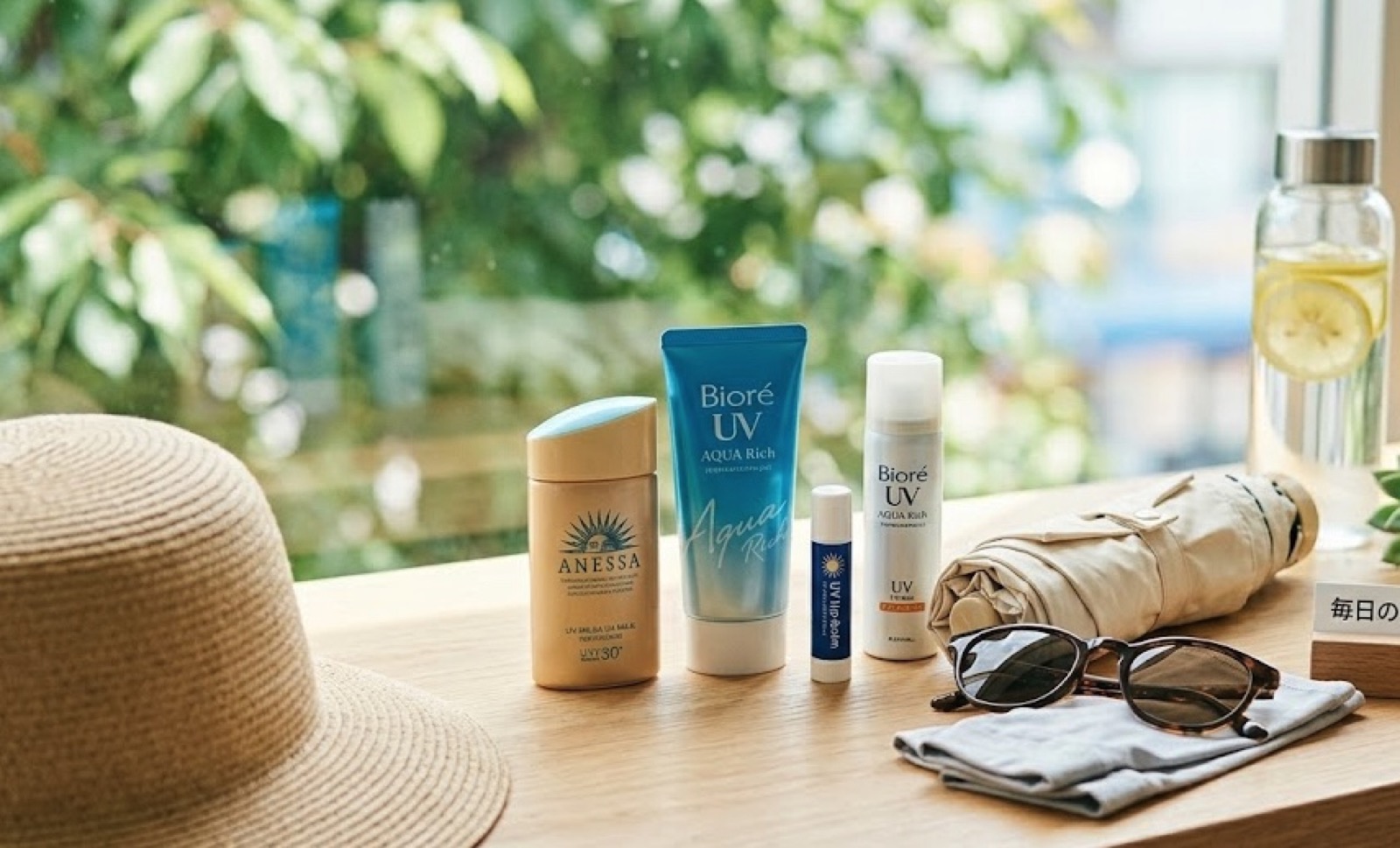
Step 5: Broad-Spectrum Daily Photoprotection (Approx. ¥800–¥1,200)
Japanese drugstore sunscreens lead the global industry in cosmetic elegance. The American Academy of Dermatology highlights:
- "Apply a broad-spectrum, water-resistant sunscreen with an SPF of 30 or higher to all skin not covered by clothing."[3]
- What to Look for: Water-gel or milk sunscreens marked with SPF 50+ and PA++++, offering maximum broad-spectrum defense against both burning UV-B and aging UV-A rays.
Category Breakdown: What to Look for at the Drugstore
Scroll horizontally to view full table
| Product Category | Typical Price Range | Key Benchmark Actives to Seek | Selection & Texture Criteria |
|---|---|---|---|
| Cleansing Oils & Foams | ¥600 – ¥1,000 | Mineral Oil, Squalane, Amino Acid Surfactants | Emulsifies instantly with lukewarm water; zero eye stinging; non-stripping rinse |
| Hydrating Lotions (*Kesho-Sui*) | ¥700 – ¥1,400 | Multi-Weight Hyaluronic Acid, Fermented Rice, Hatomugi | Available in 170ml–500ml bottles; choose Sappari for oily skin, Shittori for dry |
| Clarifying / Firming Serums | ¥1,000 – ¥1,800 | Pure Vitamin C, Tranexamic Acid, Niacinamide | Look for opaque, narrow-nozzle tubes preventing air oxidation; certified Quasi-Drug mark |
| Moisture Emulsions (*Nyueki*) | ¥800 – ¥1,500 | Ceramides, Pseudo-Ceramides, Soy Milk Isoflavones | Fluid milk consistency; absorbs within 30 seconds; leaves breathable protective barrier |
| Daily Sunscreens | ¥750 – ¥1,300 | Tinosorb S, Uvinul A Plus, Zinc Oxide, Hyaluronic Acid | Must state SPF 50+ and PA++++ on label; water-resistant; no chalky white cast |