In Western beauty routines, moisturizing is typically synonymous with applying a thick, jarred cream. In Japanese beauty (J-Beauty), however, the undisputed champion of daily moisture is the milk moisturizer—known in Japan as nyuueki (literally "milky liquid").
Rather than coating the face with a heavy, waxy layer of petrolatum, Japanese cosmetic science approaches skin barrier protection through fluid emulsification. A Japanese facial milk balances water-binding humectants with lightweight lipids, providing a breathable seal that locks in watery hydration without midday shine.
Whether you are seeking to balance oily zones, soothe sensitive skin, or master a minimalist Japanese skincare routine, understanding how a milk moisturizer functions is key to achieving long-lasting skin comfort.

Quick answer: A Japanese milk moisturizer, known locally as nyuueki (facial milk or emulsion), is a fluid emulsion of water and light emollient oils formulated to seal in hydration while mimicking the skin's natural lipid film. Unlike heavy occlusive creams that can feel suffocating or clog pores, facial milks absorb quickly with zero greasiness, smoothing rough texture and preserving natural ceramides. In Japanese double-moisturizing, it is applied immediately after a hydrating lotion (keshosui) to create soft, supple mochi skin.
What Is Nyuueki? The Concept Behind Japanese Facial Milk
The word nyuueki translates literally to "milky fluid." In Japanese skincare terminology, it refers to a lightweight, pourable or pump-dispensed lotion-emulsion designed to serve as the primary moisturizing layer.
The central pillar of Japanese skin conditioning (hadazukuri) is the concept of double moisturizing (daburu hoshitsu). In this ritual, moisturizing is divided into two distinct, complementary phases:
- Phase 1: Water Delivery: A watery, humectant-rich lotion (keshosui) floods the stratum corneum with moisture.
- Phase 2: Lipid Sealing: A facial milk (nyuueki) is applied immediately afterward to create an emollient veil that locks that water in place.
As explained by the sensitive-skin specialists at Curél (Kao Corporation):
"Japanese skincare is rooted in two-step cleansing and moisturizing rituals that work gently to prepare skin for hydration, while preserving its natural ceramides."[1]
By pairing a watery lotion with a fluid milk, you supply your skin with both water and lipids in their optimal biological sequence.

Why Milk Instead of Heavy Cream? The Science of Emulsion
To appreciate why Japanese formulators champion milk moisturizers over heavy creams, consider human skin physiology. The skin's outermost defense—the acid mantle or hydrolipidic film—is not a thick block of grease. It is a finely balanced, micro-fine emulsion composed of water, sweat, natural moisturizing factors (NMF), and physiological sebum.
A Japanese milk moisturizer is engineered to mirror this native emulsion:
- Optimal Oil-to-Water Ratio: Most Japanese milks contain roughly 70% to 80% water combined with 20% to 30% emollient lipids (such as squalane, jojoba oil, or synthetic ceramides). This fluid ratio allows the formula to spread effortlessly across facial contours without friction.
- Breathable Occlusion: Unlike petrolatum-heavy ointments that form an impermeable barrier, a milk moisturizer creates a semi-permeable moisture shield. It prevents trans-epidermal water loss (TEWL) while allowing perspiration and heat to dissipate naturally.
- Micro-Emulsion Technology: Japanese cosmetic laboratories specialize in high-pressure micro-emulsification, breaking lipid droplets down to microscopic sizes. This allows the soothing lipids to settle evenly between surface keratinocytes without leaving a greasy sheen.
Japanese skincare regimens prioritize layering from the lightest viscosity upward. As Rohto Pharmaceutical's Hada Labo Tokyo formulation team explains, a balanced routine begins by:
"starting with the lightest weight product."[3]
Applying a fluid milk after your watery lotion respects this graduation of weight, ensuring maximum absorption without product pilling. If you want to understand how emulsions compare technically with heavier creams, read our detailed guide on Japanese emulsion vs moisturizer.
How to Apply a Japanese Milk Moisturizer (Step-by-Step)
Proper application technique ensures that your facial milk seals in hydration without dragging delicate facial skin.
Step 1: Dispense the Correct Amount
Most Japanese milk moisturizers are packaged in pump bottles. For dry or sensitive skin, manufacturer guidelines recommend dispensing an adequate portion to ensure complete coverage without friction. As Curél explicitly advises:
"Apply 3-4 pumps of Curél Moisture Facial Milk to cheeks, forehead, nose and chin. Smooth milk over your face, working from the inside to the outside in long, soft strokes."[1]
If you have naturally oily skin, 2 pumps may be sufficient for daytime comfort.
Step 2: Warm Between Palms
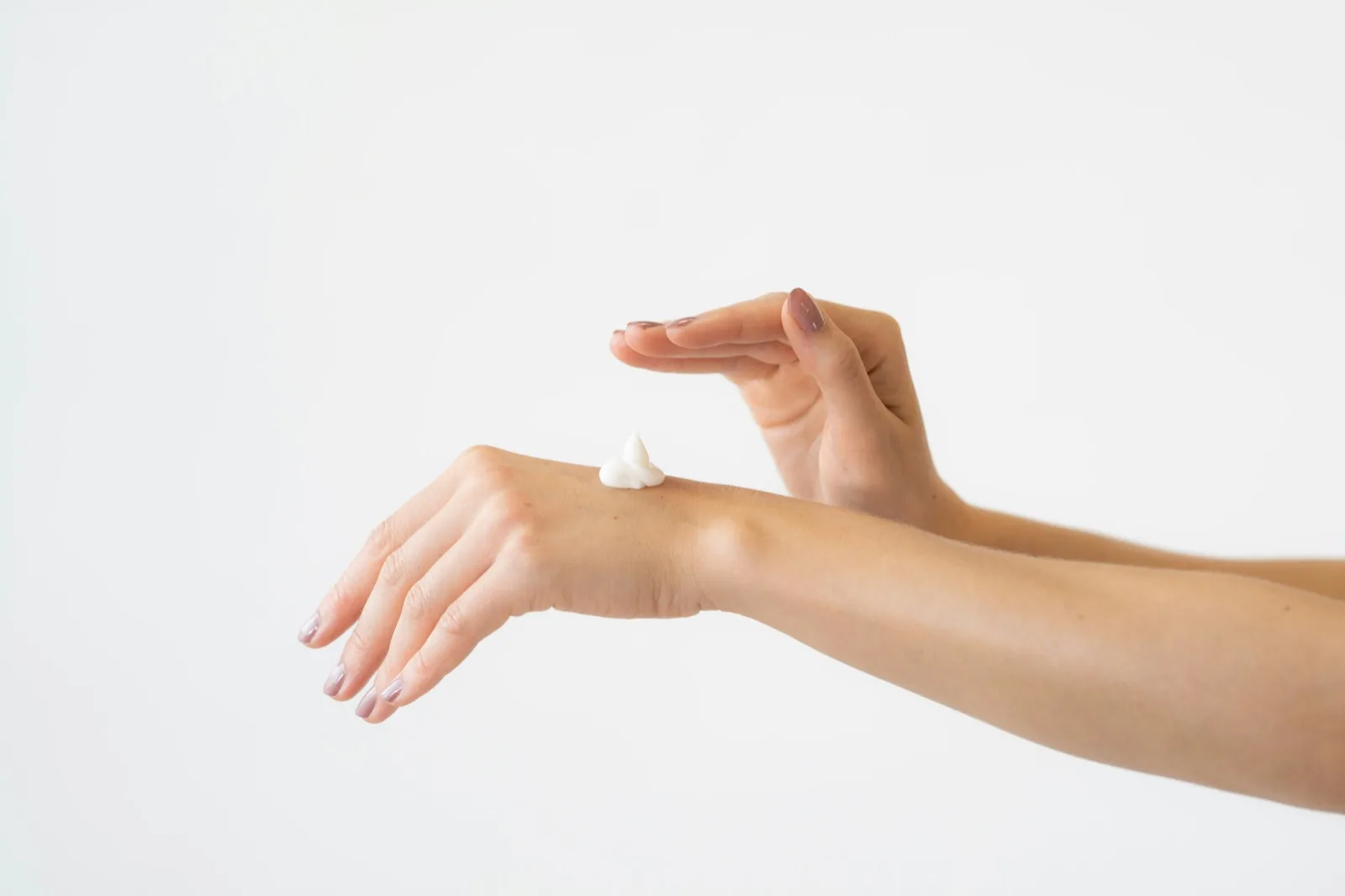
Dispense the milk into clean palms and lightly press your hands together for two to three seconds. The natural warmth of your hands reduces the surface tension of the emulsion, allowing it to glide across your facial contours smoothly.
Step 3: Glide in Long, Soft Strokes (Mimasatsu)
Distribute the milk across your cheeks, forehead, nose, and chin. Using the flat pads of your fingers, smooth the fluid outward from the center of your face toward your temples in long, continuous strokes. Never rub, pull, or drag aggressively. In Japanese beauty philosophy, friction-free application (mimasatsu) is essential to prevent micro-inflammation and premature barrier breakdown.
Step 4: Press and Cup with Warm Palms
Finish by cupping your palms over your cheeks, forehead, and chin, holding them in place for three to five seconds. The gentle pressure and warmth help the emulsion settle evenly into the upper epidermal layers, leaving a soft, velvety bounce.
Japanese Milk Moisturizer vs Heavy Cream vs Gel Moisturizer
The following comparative table illustrates how Japanese milk moisturizers differ from other standard moisturizing categories:
Scroll horizontally to view full table
| Dimension | Japanese Milk Moisturizer (Nyuueki) | Heavy Occlusive Cream | Oil-Free Gel Moisturizer |
|---|---|---|---|
| Formulation Ratio | Balanced water-oil emulsion (approx. 75% water, 25% oil) | Oil-dominant or high-lipid blend (approx. 40–50% oils/waxes) | High water / humectant content (90%+ water, minimal oil) |
| Texture & Finish | Fluid, silky, velvety semi-matte finish | Dense, rich, protective, slightly shiny | Refreshing, quick-absorbing, cooling matte |
| Primary Benefit | Locks in lotion moisture while preserving ceramides | Intensive barrier protection against harsh dry air | Hydrates oily skin without adding any lipid weight |
| Ideal Skin Profiles | All skin types, especially sensitive and combination | Severely dry, flaky, or mature skin | Very oily, acne-prone, or humid climate wear |
| Daytime Under Makeup | Exceptional; creates a smooth, non-pilling canvas | Can cause sunscreen and foundation to slide | Good, but may lack sufficient sealing power |