title: Japanese Makeup for Humid Weather: No-Melting Secrets description: Master sweat-proof Japanese makeup for humid weather. Learn how sebum-control primers, thin-veil layers, and setting mists keep your face fresh all day. published_at: '2026-11-14' updated_at: '2026-11-14' fact_checked_at: '2026-11-14' author: Miho Tanaka fact_checker: Miho Tanaka thumbnail: /images/stock/skincare-clear-water-drops-minimal-glass.jpg thumbnail_alt: Crystalline water droplets beaded on clean glass surface representing humidity resistance category: routines tags:
- humid weather makeup
- sweat proof
- j-beauty
- sebum control
- summer makeup
Japanese Makeup for Humid Weather: No-Melting Secrets
Anyone who has experienced a Japanese summer knows that the country faces one of the world's most unforgiving cosmetic environments. Between June and September, relative humidity frequently surges past 80 percent while temperatures climb into the mid-thirties Celsius. For millions of commuters navigating crowded train platforms and sun-drenched city streets, makeup is subjected to a relentless barrage of sweat, sebum, friction from face masks, and drastic temperature swings between stifling outdoor heat and chilled air-conditioned offices.
Out of sheer environmental necessity, Japanese cosmetic laboratories have perfected the science of humidity-proof beauty. Rather than piling on thick layers of matte foundation and heavy setting powders—which inevitably crack and turn cakey when mixed with perspiration—the Japanese technique relies on the golden rule of thin-veil adhesion (hakumaku misshaku). By deploying porous silica primers, flexible polymer films, and targeted setting mists, you can keep your complexion fresh, refined, and completely melt-proof from morning to night.
Quick answer: The Japanese Humidity Defense Secrets
- The Thin-Veil Rule (Hakumaku Misshaku): The less physical pigment on your skin, the less there is to slide off. Replace heavy liquid foundation with an ultra-thin sebum-control UV base.
- Porous Silica Primers: Japanese kawa-kuzure boushi primers contain microscopic hollow silica beads that continuously absorb excess sebum without drying out the barrier.
- The Sandwich Setting Technique: Locking the base with a light veil of setting mist both before and after a minimal dusting of translucent micro-powder.
- Polymer Tubing Mascaras: Warm-water-removable film mascaras that form smudge-proof plastic sleeves around lashes, impervious to sweat and facial sebum.
The Climate Crucible: Why Japan Perfected Humidity-Resistant Makeup
To understand why Japanese humidity-proof cosmetics are so uniquely resilient, it helps to analyze why conventional Western summer makeup strategies fail in humid climates:
Why "Baking" Fails in Real Humidity
The popular Western technique of "baking"—packing thick layers of loose translucent powder over heavy concealer and foundation—relies on an arid or air-conditioned environment. When exposed to 85 percent ambient humidity and facial perspiration, heavy powder absorbs sweat until it becomes saturated, turning into a paste. The moment facial muscles move, this saturated paste cracks, pools into fine lines, and separates around the nostrils and smile lines.
The Japanese Approach: Flexible Film Formation
Instead of attempting to absorb every drop of perspiration through heavy talc, Japanese cosmetic chemists utilize flexible, breathable mesh polymers. These micro-films bond directly to the stratum corneum, allowing perspiration and sebum to pass through the microscopic matrix without dislodging the underlying pigment. The skin continues to breathe, while the makeup remains locked firmly in place.
Corporate beauty innovators, including Shiseido Company, Limited, consistently advance optical light-scattering research and photoprotective skincare foundations to enhance natural skin luminosity [1].
The Golden Rule: Thin-Veil Adhesion (Hakumaku Misshaku)
In Japanese professional makeup artistry, the foundational principle for hot weather is hakumaku misshaku—applying the thinnest possible veil with maximum surface adhesion.
Consider the physics of makeup breakdown: a thick layer of foundation has significant physical mass. When sebum surfaces between the skin and the makeup layer, that heavy mass easily slides around. By contrast, an ultra-sheer veil has virtually no mass, allowing the formula to anchor tenaciously to skin contours even when the skin sweats profusely.
Cooling Skin Prep Before Application
Long before applying pigment, temperature control is essential. If your face is warm and flushed when you start your morning routine, pores remain dilated and sweat glands begin firing immediately, preventing primers from adhering. Japanese beauty experts recommend:
- Chilled Hydrating Lotion: Patting a generous layer of chilled hydrating toner (keshosui) into the skin using clean palms.
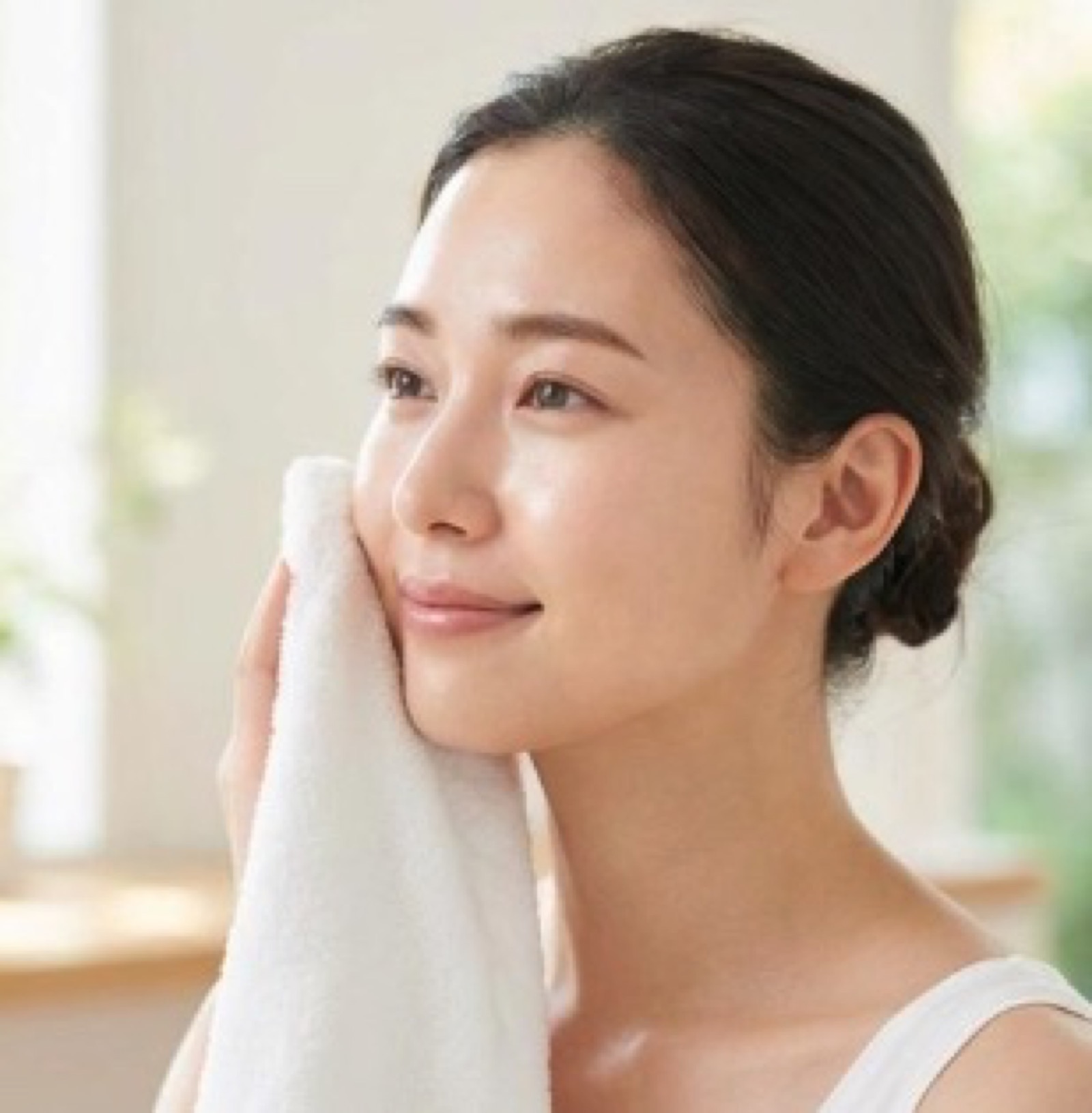
- Cold Towel Press: Pressing a cool, damp washcloth over the neck and temples for sixty seconds to bring down facial skin temperature.
- Blotting Excess Morning Skincare: Pressing a single ply of clean facial tissue over the face to remove any unabsorbed surface emollients before beginning base makeup.
The 5-Step Japanese Humidity Defense Protocol
Follow this sequence to construct an imperceptible, all-day sweat-proof base:
Step 1: Pre-Makeup Stratum Corneum Hydration
Dehydrated skin compensates for high heat by pumping out excessive sebum. Saturate the upper epidermal layers with a lightweight, oil-free lotion (keshosui) enriched with hyaluronic acid or trehalose, followed by a feather-light gel emulsion. Allow two full minutes for skincare to absorb completely.
Step 2: Sebum-Control Primer (Kawa-Kuzure Boushi Shitaji)
The true hero of Japanese humid-weather makeup is the sebum-blocking primer (shitaji). Major Japanese beauty conglomerates like Kao Corporation develop micro-defense formulation science to ensure uniform daily coverage while maintaining weightless skin comfort [2].
Formulated with porous spherical silica and zinc oxide, these milks form a smooth matte veil across the central T-zone. Dispense a dime-sized amount and press firmly into areas prone to shine—the forehead, nose, and chin—buffing gently into pores with clean fingertips.
Step 3: Pinpoint Micro-Concealing Instead of Full Foundation
Skip liquid foundation entirely. Take a high-adhesion liquid or pot concealer and a fine detail brush. Place tiny micro-dots solely over active blemishes, dark spots, or inner-eye darkness, tapping the edges seamlessly into the bare primer veil. Eighty percent of your face remains covered only by the breathable primer.
Step 4: The Sandwich Setting Technique
Lock the base in place using the sandwich method:
- First Mist Layer: Hold a Japanese makeup setting spray containing film-forming polymers approximately 20 centimeters from your face and spritz in an "X" and "T" pattern. Allow it to air-dry without touching.
- Micro-Fine Powder Press: Take a velvet puff loaded with finely milled translucent silica powder, fold the puff in half, and press it gently into the sides of the nose, between the brows, and the center of the chin. Avoid dusting cheeks to retain natural radiance.
- Second Mist Layer: Finish with a light final mist to melt the powder into an invisible, waterproof shield.
Step 5: Film-Type Eye Cosmetics (Tubing Mascaras)
Under humid conditions, creamy waterproof mascaras (which are oil-soluble) quickly dissolve when hit by oily eyelid sebum, creating stubborn panda eyes. Japanese tubing mascaras utilize water-based acrylic polymers that wrap individual lashes in flexible plastic sleeves. They are 100 percent impervious to sweat, sebum, and high humidity, yet slide off effortlessly when rinsed with warm water (38 degrees Celsius) at night.

Comparative Analysis: Western Baking vs Japanese Thin-Film Defense
Scroll horizontally to view full table
| Factor | Heavy Western "Baking" Routine | Japanese Thin-Film Defense (*Hakumaku*) |
|---|---|---|
| Layer Thickness | Thick primer + full-coverage liquid foundation + heavy powder | Ultra-thin sebum-control primer + pinpoint spot concealer |
| Reaction to Sweat | Powder turns into paste; foundation separates and cakes | Sweat beads roll over breathable polymer film without moving it |
| Midday Sensation | Heavy, tight, occlusive, feels suffocating in heat | Weightless, fresh, feels like bare conditioned skin |
| Pore Interaction | Settles into pores, creating visible white dots when oily | Porous silica continuously traps sebum inside microscopic pores |
| Evening Removal | Aggressive double cleansing with heavy balms required | Removes gently with mild foaming cleanser and warm water |